by Kurt Kober
Frederic Petit, known to his friends as “Chappy,” because of his perennially shredded lips, was an interesting sort of a fellow, if a bit odd. His hair waved like a frozen splash of dirty brown water on his head. His most prominent facial feature was a large, raised mole high on his left cheekbone that occasionally had a few coarse hairs twisting out of it, but more often than not was kept neatly plucked. It is said that even his wife couldn’t stand the sight of the thing, which appeared rather suddenly in the winter of 1846. His friends called it an “ass biscuit” which was strange since it was nowhere near his ass (although maybe they thought it was transferred from somebody else’s), and no pictures of Frederic Petit’s ass persist to this day.
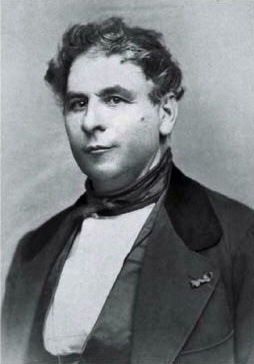
What does persist to this day is Frederic Petit’s crowning research paper entitled (roughly translated from his French gutter dialect) “The Very Fast Thing That I Seen Which Is A Moon” wherein Mssr. Petit described the astronomical properties of what he deemed to be the second satellite of earth. (The first being ol’ one-eye, the Moon.
Petit’s lune deux was a small, yet massive, object, traveling at approximately 11.7 kilometers of altitude, and making one revolution around our planet every three hours or so, a speed of 8284 miles per hour.
Many were skeptical. One man who was not was a friend of Frederic’s, an author of ill repute and cheap science fiction known as Jules Verne. (His real name was La’Ranje Julius but his publisher gave him the more snappy moniker.) Jules even mentioned the little moon in his book “From The Earth To The Moon” and nobody cared.
Because who would believe it? 11.7 kilometers is just about the cruising altitude of most modern jetliners and not many of them have been knocked out of the sky by the weirdest moon ever.
Readers with irritatingly exceptional cognitive capacity will by now have noted smugly that earth orbital velocity at a height of 11.7 kilometers is not 8500 miles per hour but a decidedly less pokey 17 thousand miles per hour, with an orbital period of 1.4 hours, not three hours. Because orbits are orbits and they don’t give a shit how fast you want to go or how high you are, you’re locked in, baby.
A moon with a three-hour period around the earth would actually travel at 4200 kilometers with a speed of 13700 miles per hour.
By which we mean to say, not indelicately but matter-of-factly: Frederic Petit was batshit insane.
The preceding is prologue. And, if I’m honest, it is also most of the story. But now that you know this, what’s your opinion of ol’ Chappy? You might agree he was crazy. And at the very least, if not pathological, then ol’ ass biscuit was a huckster trying to make a name for himself.
But ol’ Chappy wasn’t wrong! I have it on good authority that in 1846 there was an artificial object moving around Earth, and it did so in such a way that it slightly perturbed the orbit of our own Moon, because it used said planetary satellite as a gravitational pivot point while passing over our dimly civilized planet just one time, before careening shimmeringly to the outer depths just past Zeta Reticuli. Our own moon returned completely to normal, as quantum drive waveform collapses never result in any permanent alteration to the fabric of space-time, and thus, Petit’s sole observations of an extrasolar visitor led him to the erroneous belief in another moon—albeit a very strange one.
Frederic Petit obviously made no more observations of this moon, and despite paying colleagues to claim they also saw it, and despite standing on his roof and squinting upwards for hours to try to see it go by, he never caught sight of this massive little object blasting past at eight thousand miles per hour again. And this, no matter how much he drank.
It wasn’t all a chore, however, because Petit’s rooftop vantage point afforded him not just a perfect view of the grand reaches of the great star-littered unknown that lies beyond the limits of our terrestrial knowledge, but also the apartment of Monique Lestat, just across the way, and fortunately, the best times for moon two searching coincided with Mme. Lestat’s bath time and various habits of toiletry.
Frederic, therefore, observed many moons, and other baser fascinations, but not the one moon that would have afforded him any kind of legitimate lasting fame. His observations of the more grounded phenomena afforded him a strange consolation, you might say a rigidity of belief, which he never revealed to his wife, but which ass biscuit could never unsee.
FIN